
FIFA World Cup 2026 Rule Changes Explained: VAR Expansion, Anti-Time-Wasting Laws and Red Cards for Covering Your Mouth
With the FIFA World Cup 2026 kicking off on June 11, the International Football Association Board (IFAB) has approved a landmark set of rule changes that will reshape the way matches are played — and watched — across all 16 host venues in the USA, Canada and Mexico.
IFAB's Historic Meeting: What Changed and When
On May 31, 2026, the International Football Association Board (IFAB) — the body responsible for the laws of football — held its annual meeting in Hensol, Wales, and approved a sweeping package of amendments. The changes take effect from the start of the 2026–27 season and will be implemented immediately at the 2026 FIFA World Cup, making this tournament the first major global stage where fans will see every one of these rules in action simultaneously.
The objectives are clear: tackle discrimination, cut time-wasting, enhance match tempo and improve the experience for both players and supporters watching in stadiums and on screens around the world. This is the most significant single batch of law amendments since the widespread introduction of VAR in 2018.
Red Card for Covering Your Mouth
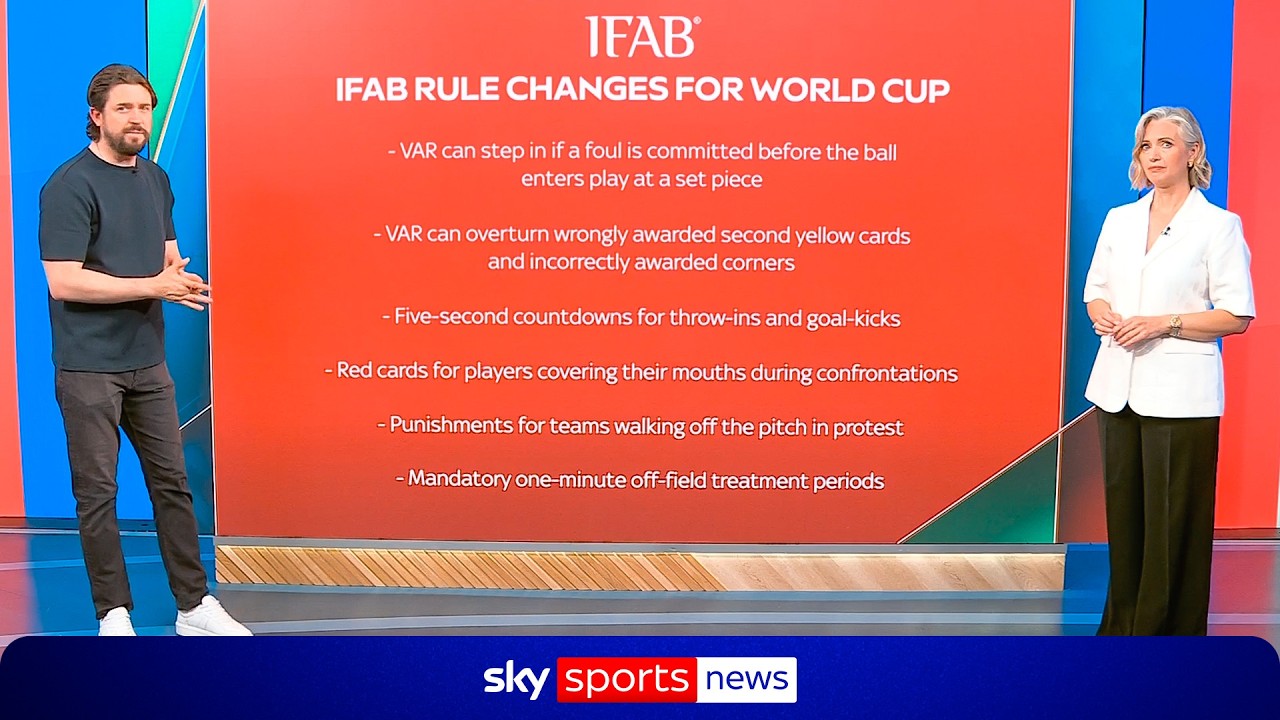
Perhaps the most striking change is one that targets player conduct during confrontations on the pitch. Under the new laws, any player who covers their mouth — whether with their hand, arm or shirt — during a heated exchange with an opponent can be shown a straight red card. IFAB confirmed the rationale: when a conversation turns confrontational, concealing what is being said strongly implies abuse, offensive language or discriminatory remarks.
However, the rule includes an important nuance. Players will not be punished if they cover their mouths during clearly friendly conversations — for example, when speaking quietly with a former club teammate from the opposing national squad. Referees will be expected to read the context carefully, and this interpretation will undoubtedly generate debate in the early rounds of the tournament.
The change is part of a broader push to eliminate discrimination from football. FIFA and IFAB have made combating abusive language one of their central priorities ahead of a World Cup that will be broadcast to billions across the globe.
VAR Expansion: Three New Situations
Video Assistant Referee technology has been part of FIFA World Cups since 2018, but its scope has always been tightly limited. For 2026, IFAB has approved three new situations in which VAR can intervene, addressing some of the most glaring inconsistencies that have frustrated players, coaches and fans in recent tournaments.
| New VAR Situation | What It Covers |
|---|---|
| Incorrect second yellow card | VAR can review and overturn a clearly incorrect second booking that would lead to a red card |
| Mistaken identity | VAR can correct cases where the wrong player receives a yellow or red card |
| Incorrectly awarded corner kick | VAR can intervene if a corner is awarded when it should not have been — but only if the correction can be made immediately without delaying restart |
Notably, the third scenario has a limitation: VAR can be used to reverse an incorrectly given corner kick, but it cannot convert a goal kick into a corner kick in the other direction. This deliberate asymmetry is designed to prevent VAR interventions from constantly disrupting the flow of play.
VAR will also be permitted to review incidents occurring immediately before the ball is put back into play during set pieces — closing a loophole that has been exploited in previous tournaments.
Anti-Time-Wasting: The 5-Second Countdown
Time-wasting has long been one of football's most frustrating tactics, and the 2026 World Cup will mark the first time a structured countdown mechanism is introduced at the highest level. Referees will now visually raise their hand and begin a five-second countdown for all throw-ins and goal kicks.
- Throw-ins: If the ball is not put into play within five seconds, the opposing team is awarded the throw-in instead.
- Goal kicks: If the goalkeeper does not take the goal kick within five seconds after the countdown begins, the opposing team is awarded a corner kick.
This change is expected to have a significant impact on matches where a team is protecting a narrow lead in the final stages, eliminating the ability of goalkeepers to hold the ball for extended periods under the guise of repositioning players. The ban on tactical timeouts by goalkeepers is directly connected to this measure, closing a loophole that was widely used to break up attacking momentum.
10-Second Substitution Rule
Substitutions have become another vehicle for time-wasting, with players routinely walking slowly to the touchline to burn precious seconds. Under the new rule, once the fourth official raises the substitution board, the outgoing player has exactly 10 seconds to leave the field of play. Failure to exit within this window risks delaying the entry of the replacement player — and could result in disciplinary action from the referee.
This change is expected to speed up the substitution process significantly, particularly in the closing minutes of tight knockout matches where every second counts. In the past, it was not uncommon for a single substitution to consume more than 60 seconds of actual playing time when player theatrics were factored in.
Mandatory Hydration Breaks
Every match at the 2026 FIFA World Cup — including games played indoors — will include a mandatory three-minute hydration break in each half. These breaks will occur at approximately the 23rd minute of each half, although the precise timing is at the referee's discretion based on the natural flow of play.
The introduction of mandatory breaks even for indoor venues, such as SoFi Stadium in Los Angeles, reflects FIFA's commitment to player welfare across all conditions. Several host cities, including Miami, Atlanta and Dallas, are known for extreme summer heat and humidity, making hydration management a genuine safety concern for players during a tournament that spans six weeks.
You can check the full FIFA World Cup 2026 format and schedule to see which matches are at risk of the most intense heat conditions.
Body Cameras for Referees
In a first for any FIFA World Cup, referees at the 2026 tournament will be permitted to use body cameras during matches. This innovation aims to improve transparency and provide additional footage for officiating reviews. While the cameras are not intended to replace or supplement VAR in real time, the footage could prove invaluable for post-match disciplinary reviews and for improving referee education globally.
FIFA has not confirmed whether all referees or only a selected group will carry body cameras, but the principle has been approved by IFAB as part of the broader rules package.
What This Means for Teams at the 2026 World Cup
The combined effect of these rules is a tournament that promises to be faster, fairer and less tolerant of cynical tactics. Coaches will need to brief their squads carefully — particularly on the mouth-covering rule and the time-wasting countdown, which will require behavioral adjustments from players accustomed to using those moments to their advantage.
For the 48-team tournament format, where the group stage alone involves 72 matches, these changes could have a decisive cumulative impact. A single wrongly awarded corner reversed by VAR, or a red card for covering a mouth at a critical moment, could alter the trajectory of a group.
Teams should also factor in the injury implications of the new pace demands. Our FIFA World Cup 2026 Injury Report tracks which stars are racing to be fit before kick-off — and a faster, more intense game could increase the physical load on already stretched squads.
Frequently Asked Questions
No. The red card only applies when the mouth-covering occurs during a confrontational exchange with an opponent. Players covering their mouths during friendly conversations — for example, to share a joke or quietly greet a former teammate — will not be penalised. Referee discretion and context are central to the rule.
No. The expanded VAR protocol allows review of incorrectly awarded corner kicks — meaning VAR can take away a corner that was wrongly given — but it cannot convert a goal kick into a corner in the opposing direction. The correction must also be possible without causing significant delay to the restart.
IFAB — the International Football Association Board — is the body that determines the Laws of the Game. It was founded in 1886 and consists of four members: FIFA (holding 50% of the vote) and the four British football associations — England, Scotland, Wales and Northern Ireland — each holding 12.5%. All changes to football's rules must be approved by IFAB.
Yes. FIFA confirmed that mandatory three-minute hydration breaks will apply to every match at the 2026 World Cup, including those played at indoor and climate-controlled venues. This reflects a universal player welfare standard rather than a heat-specific protocol.
Under the new countdown rule, if the goalkeeper does not take the goal kick within five seconds after the referee raises the countdown hand signal, the opposing team is awarded a corner kick. This eliminates the ability of goalkeepers to stall for time under the guise of organising their defensive shape.