
FIFA, FIFPRO In Talks Over World Cup 2026 Heat Protocol As Semifinals Hit Dallas And Atlanta
With France facing Spain in Dallas on July 14 and Argentina meeting England in Atlanta on July 15, FIFA and the global players' union are reportedly discussing firmer rules on excessive heat — a conversation that has trailed the tournament since the group stage.
FIFA and FIFPRO, the worldwide players' union, are reportedly in discussions over establishing a more formal heat protocol for World Cup matches, according to sources cited by ESPN, as the tournament reaches its penultimate round with two matches in cities known for brutal summer conditions. The timing is not incidental: the semifinals send France against Spain to AT&T Stadium in Dallas on Tuesday, July 14, and Argentina against England to Mercedes-Benz Stadium in Atlanta on Wednesday, July 15, with both matches kicking off at 3:00 p.m. ET — in the heart of the afternoon heat window in two cities that have appeared repeatedly on climate researchers' lists of highest-risk World Cup venues.
The discussions reportedly follow a tournament-long undercurrent of concern from FIFPRO, which has pushed for a more conservative heat-safety standard than the one FIFA currently applies. FIFA's existing threshold calls for mandatory cooling breaks when the Wet Bulb Globe Temperature (WBGT) — a measure combining air temperature, humidity, sunlight, and wind — reaches 32°C (89.6°F), with postponement only considered beyond that point. FIFPRO's own recommendation is considerably stricter: cooling breaks starting at 26°C (79°F) WBGT, with postponement or suspension evaluated once conditions cross 28°C (82°F). An analysis by the climate research group World Weather Attribution reportedly found that roughly a quarter of the tournament's 104 matches were likely to be played in conditions exceeding FIFPRO's recommended safety limit, with as many as five matches potentially falling into the "unsafe" category outright — compared to just three at the 1994 World Cup, also hosted in the United States.
What Changed This Time: Hydration Breaks For Every Match
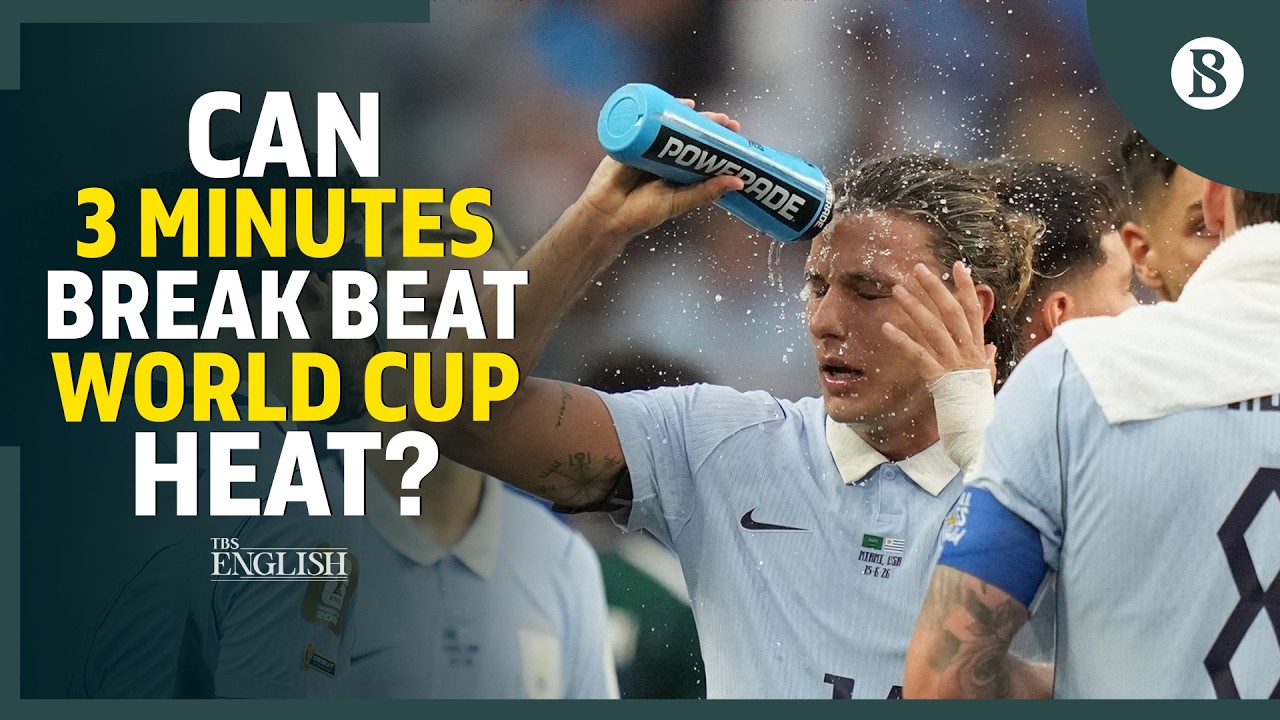
Unlike prior tournaments, where cooling breaks were triggered only once heat thresholds were crossed, FIFA built a blanket hydration break into this World Cup from the start. Every match — regardless of temperature, city, or roof status — includes a three-minute stoppage roughly 22 minutes into each half, called by the referee to let players rehydrate. FIFA has framed the move as a player-welfare measure applied uniformly so no team gains or loses an advantage based on local conditions. The policy has not been without controversy: some fans and commentators have criticized the breaks for disrupting match flow, and FIFA has confirmed that broadcasters are permitted to run advertising during the stoppages, fueling accusations that commercial interests are at least partly behind the change. Scientists have also questioned whether a three-minute break is long enough to meaningfully cool players down or rehydrate them when conditions are genuinely severe.
FIFPRO's position has been that hydration breaks alone do not amount to a real heat protocol. Alex Phillips, FIFPRO's deputy general secretary, said earlier this year that FIFA was "likely to be more flexible" on kickoff times after seeing the effects of extreme heat during the 2025 Club World Cup, though he cautioned the union has "absolutely no power to force" FIFA's hand and instead relies on "common-sense arguments," pointing to precedents like MLS avoiding midday kickoffs in Florida. Phillips has also said FIFPRO's dealings with FIFA on the issue have largely stayed at an informal, technical level rather than producing a codified agreement — which is reportedly what the union is now pushing for as the tournament nears its close.
Some of that urgency traces back to last year's Club World Cup, a dry run of sorts for this summer's heat conditions across many of the same U.S. venues. During a semifinal at MetLife Stadium in July 2025, with temperatures around 96°F (about 36°C) and humidity above 54%, Chelsea midfielder Enzo Fernández had to lie down on the pitch after becoming disoriented. "The heat was incredible. I got dizzy during a play and had to drop to the ground. Playing in these temperatures is very dangerous," Fernández said afterward. Reporting around that tournament found that in 31 of 57 games, the average WBGT exceeded 82°F, well past FIFPRO's postponement-review threshold.
Heat Concerns Have Shadowed The Tournament Since The Group Stage
Heat has been a recurring storyline well before the semifinals. Reporting during the group and knockout rounds flagged matches in Kansas City and Miami played under extreme-heat advisories, with "feels like" readings reportedly climbing as high as 43°C (110°F) in some cases, and Monterrey — one of the hottest open-air venues on the map — has had several of its matches shifted to evening kickoffs specifically to avoid the worst of the midday heat. England manager Thomas Tuchel said ahead of the tournament that his squad had prepared specific "cooling strategies" and that staff understood "the individual reaction of the players to the heat," while captain Harry Kane downplayed the threat, saying the conditions "won't be a factor" given England's training regimen — a claim that will be tested again when his side faces Argentina in Atlanta. Notably, both semifinal venues have retractable roofs and climate-controlled interiors, which should shield players from the most extreme conditions once the roof is closed, even if fans moving through outdoor plazas beforehand face a different story: meteorologists have warned that pavement temperatures outside stadiums like Dallas's can reportedly climb far higher than the air temperature itself.
For fans following the France vs Spain semifinal preview, the heat conversation adds another layer of context beyond the tactics: how each squad manages recovery and hydration between now and kickoff could matter as much as the matchups on paper. Atlanta's build-up follows a similar thread, as detailed in coverage of the Day 32 results that set up the Argentina-England semifinal.
What Happens Next
No formal, jointly agreed heat protocol has been announced as of this writing — the discussions between FIFA and FIFPRO are reportedly ongoing rather than concluded, and it remains unclear whether any binding changes could apply before the final at MetLife Stadium on July 19. FIFPRO has indicated it wants the conversation to produce established rules for future tournaments regardless of what happens over the final week of this one, given that North American summers are expected to keep producing similar conditions. For now, players in Dallas and Atlanta will rely on the roofed stadiums, the mandatory hydration breaks, and their own preparation to get through two of the most physically demanding matches of the tournament.
Frequently Asked Questions
Not a jointly agreed, formal one as of July 13, 2026. FIFA applies its own WBGT-based threshold (mandatory cooling break consideration at 32°C), while FIFPRO recommends a stricter standard (26°C for cooling breaks, 28°C for postponement review). The two sides are reportedly in talks to align on firmer rules, according to sources cited by ESPN.
Both AT&T Stadium (Dallas) and Mercedes-Benz Stadium (Atlanta) have retractable roofs and climate-controlled interiors, which should limit direct heat exposure for players once the roof is closed. Both cities have appeared on researchers' lists of the tournament's highest heat-risk venues, and both matches kick off at 3:00 p.m. ET, during the hottest part of the day outside.
FIFA introduced a three-minute hydration break in every match, roughly 22 minutes into each half, regardless of temperature or venue. It's a departure from past tournaments, where breaks were only triggered once specific heat thresholds were crossed.